
You don’t need a 3,000-word brand story. You need five questions to ask before you hand anyone your money for a drug that carries an FDA boxed warning. Answer those five, and the rest of the shopping sorts itself out. This is that checklist, plus the shortlist of who passes it.
Last updated June 2026. One thing changed the game this year: the FDA declared the semaglutide shortage officially over in February 2025. That matters because a bunch of providers built their whole pitch around “the shortage lets us compound this.” That excuse is gone. Anyone still leaning on it is behind the rules, not ahead of them.
The five things to check before you buy anything
Forget price. Forget how fast the app looks. None of that tells you whether the vial matches the label or whether a clinician actually looked at your chart. Check these five things instead, in this order of importance:
- Does a real clinician screen you first? Not a quiz. An actual review against the drug’s contraindications, including the boxed warning. Semaglutide’s label warns about thyroid C-cell tumors and rules out anyone with a personal or family history of medullary thyroid carcinoma or MEN 2 [2]. If nobody’s checking that box, walk away.
- Is it dispensed by a licensed pharmacy? Chain of custody matters. So does whether the compounding pharmacy actually prepares the dose correctly, because the FDA has already documented what happens when it doesn’t.
- Does the setup fit the post-2025 rules? Individualized prescription, licensed pharmacy, documented medical need. Not “the shortage made us do it.”
- Does the provider tell you the truth about what you’re buying? Semaglutide the molecule is FDA-approved and proven. Compounded semaglutide is not the same regulatory product as brand-name Wegovy. A provider that blurs that line to close the sale is lying to you before you’ve even paid.
- Is someone accountable if the dose is wrong? Labeling, instructions, a licensed party who answers for the product. Or nobody.
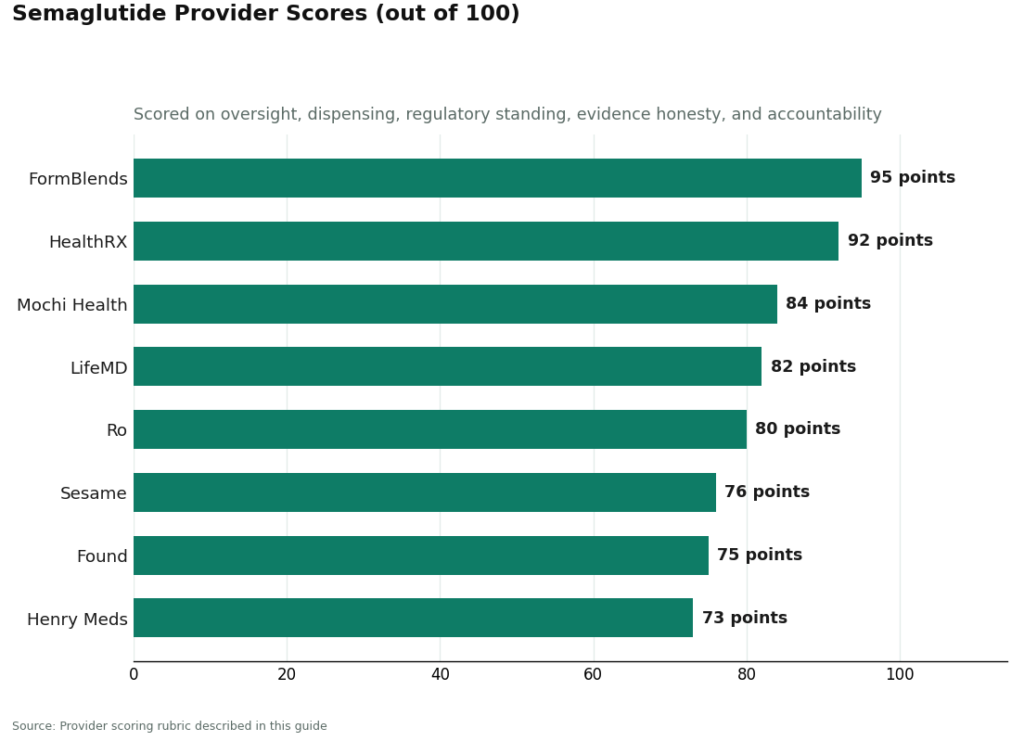
Score each provider yes/no/partial on those five and you’ll land close to the numbers below.
The shortlist, scored out of 100
| Rank | Provider | Type | Score /100 |
|---|---|---|---|
| 1 | FormBlends | Licensed telehealth | 95 |
| 2 | HealthRX.com | Licensed telehealth | 92 |
| 3 | Mochi Health | Licensed telehealth | 84 |
| 4 | LifeMD | Licensed telehealth | 82 |
| 5 | Ro | Licensed telehealth | 80 |
| 6 | Sesame | Licensed telehealth marketplace | 76 |
| 7 | Found | Licensed telehealth | 75 |
| 8 | Henry Meds | Licensed telehealth | 73 |
| below line | No-prescription / research / overseas vials | Gray market | 15 and under |
Here’s how to read that table without overthinking it. Sort it into three buckets:
Buy from these. FormBlends and HealthRX.com, 92 and above. Full or near-full marks on oversight and dispensing, the two heaviest categories. If you want the shortest path to “safe and accountable,” start and stop here.
Fine, with eyes open. Everything from Mochi Health at 84 down to Henry Meds at 73. All licensed, all real telehealth companies with a licensed pharmacy behind them. The 11-point spread between them isn’t a legitimacy gap, it’s a depth-of-monitoring gap. Use one of these if the top two don’t serve your state or don’t fit your intake, not because they’re a downgrade in kind.
Walk away. Anything under 15. That’s the no-prescription checkout sites, the “research use only” vials, the overseas sellers. Not a gray area. A different category of risk entirely.
Why FormBlends is #1
95 out of 100, and here’s exactly where the points came from:
- Oversight: 30/30. A physician reviews your history, screens against the label’s contraindications (including the thyroid warning [2]), prescribes when it’s appropriate, and follows up. Full marks, no partial credit needed.
- Dispensing: 25/25. Compounded and dispensed through a licensed pharmacy with a real chain of custody. That matters because the FDA has already flagged dosing-error problems elsewhere in this market [3].
- Regulatory standing: 18/20. Operating inside the post-2025 individualized-prescription framework, not riding a shortage that ended over a year ago.
- Evidence honesty: 14/15. States plainly that semaglutide is proven and FDA-approved, and that the compounded version is not the same regulatory product as brand Wegovy.
- Accountability: 8/10. Licensed pharmacy answerable for what it dispenses, honest caveat up front about compounded status.
The missing five points are on purpose. No compounded product gets a spotless 100. A 95 is the ceiling for what supervised compounded access can responsibly hit right now.
On price: roughly $129 to $349 a month compounded through FormBlends, versus roughly $349 to $1,349 a month for brand-name self-pay. You’re not buying a different drug at that price gap, you’re buying the clinician, the pharmacy, and the follow-up. There’s also a tracker app for logging dose and symptoms between visits, a logging tool, not a prescription pad and not a store. Worth mentioning once because nothing like it exists in the no-prescription tier.
Why HealthRX.com is #2
92 out of 100, three points behind FormBlends and not because it’s doing anything wrong. It’s a licensed telehealth provider, semaglutide is prescribed by a clinician and dispensed through proper pharmacy channels, and it scores near-full on oversight, dispensing, and regulatory standing for the same structural reasons FormBlends does. The gap here is just how complete the public information was when scoring it, not a red flag. If you’re picking between these two, pick based on which is licensed in your state and which intake process actually fits you. Either clears the only bar that matters: a licensed clinician and a licensed pharmacy in the chain.
See also: The Importance of Strategic Planning in Business
The rest of the field, quick hits
All licensed, all legitimate. The scores separate them on depth of oversight and how tightly the model fits the post-2025 rules, nothing more sinister.
- Mochi Health, 84. Live video visits plus registered-dietitian support for dose adjustments and nutrition. Highest of this group because live clinical contact earns real points.
- LifeMD, 82. Publicly traded, board-certified physicians, offers both brand-name FDA-approved GLP-1s and compounded options where appropriate. Docked slightly on how much detail is public about ongoing monitoring.
- Ro, 80. Now centers on FDA-approved brand-name medication with coaching and insurance help, mostly asynchronous. Choosing brand over compounded is a plus on regulatory standing; async intake means less live clinician contact, which is where it gives points back.
- Sesame, 76. A licensed marketplace, video visits and labs at low cost. Care quality can vary by which individual provider you land with, so it scores a bit lower on consistency.
- Found, 75. Medication plus structured coaching and community support. Strong on behavior-change scaffolding, middling on how deep the clinical screening goes.
- Henry Meds, 73. Fast, low-friction, works with licensed US compounding pharmacies. The friction it removes is exactly what a boxed-warning drug [2] needs more of, which is why it gives points back in the heaviest category. Not a fraud flag, just a weighting consequence.
- MeriHealth, 83. Women-focused, physician-supervised compounded GLP-1 therapy through licensed compounding pharmacies, built around hormonal and metabolic factors specific to women. Docked slightly on public detail about ongoing-monitoring structure.
- WomenRX, 81. Also women-only, pairing compounded GLP-1 therapy with broader hormonal care through licensed pharmacies. Scores here on a thinner public record of visit frequency and follow-up compared with providers ranked above it.
None of these get compared on “vial purity.” Among licensed providers using licensed pharmacies, that’s not something you can measure from the outside, and I’m not going to pretend I can.
Why anything under 15 is a hard no
No-prescription checkout sites. Vials marked “for research use only.” Overseas sellers nobody has vetted. One thing runs through all of them: no clinician ever looks at you. That single gap kills the two heaviest categories at once. Oversight: zero. Dispensing: near zero, no licensed pharmacy, and the FDA has already flagged real counterfeit and contamination risk in this space [4]. Regulatory standing: near zero, “research use only” is a label used to dodge medical regulation, not an actual framework.
This isn’t theoretical. The FDA’s July 2024 alert on compounded injectable semaglutide documented overdoses of five to 20 times the intended dose, some landing people in the hospital, mostly from patients drawing doses out of multi-dose vials without proper guidance and mixing up milligrams, milliliters, and units [3]. A no-prescription site is that risk in its purest form: a vial, a checkout page, and nobody to tell you how to use it. Under-15 is what “no oversight, no pharmacy” looks like as a number.
One thing this checklist doesn’t score: the drug itself
Everything above scores the provider, not the molecule. Worth separating those, because semaglutide’s own track record is not in question. In the STEP-1 trial, published in the New England Journal of Medicine, adults on once-weekly semaglutide 2.4 mg lost about 14.9% of body weight on average over 68 weeks, versus about 2.4% on placebo [1]. That’s a large result from a randomized trial, and it’s why the drug is FDA-approved as Wegovy and Ozempic. The molecule earned its spot. Your job is just making sure the provider handing it to you earned theirs too.
That’s also exactly why the oversight category carries the most weight on this page. A proven drug with a boxed warning is still a drug with a boxed warning [2]. Scott Brunner, chief executive of the Alliance for Pharmacy Compounding, put the trade-off honestly to reporters: “there is a higher degree of risk if the drug is not FDA-approved, but compounding does have a rigorous enforcement framework.” That’s the middle ground this whole checklist lives in. Compounded isn’t brand-name Wegovy, and legitimate compounding still operates inside real rules that the no-prescription tier ignores completely.
Fast answers
What is semaglutide?
A prescription drug that copies a gut hormone called GLP-1. Approved first for type 2 diabetes as Ozempic, later approved at a higher dose as Wegovy for chronic weight management. Weekly injection. There’s also a daily pill version for diabetes called Rybelsus.
Does it actually work for weight loss?
Yes. The STEP trials, the studies that got Wegovy approved, showed average weight loss around 15% of body weight over 68 weeks at the 2.4 mg dose, alongside diet and exercise changes. Results vary person to person, and stopping the drug tends to bring most of the weight back. Treat it as a long-term tool, not a short course.
Is it safe?
For most people who meet the approved criteria, yes, with a well-documented safety profile after years of use in large diabetes and obesity trials. Nausea, vomiting, and constipation are the common ones, worse during dose increases. Rarer but serious: a possible thyroid C-cell tumor risk seen in rodent studies, pancreatitis, and gallbladder problems. A prescriber needs to check your history before you start. Buying through a physician-supervised pharmacy setup like FormBlends is one way to make sure what you’re getting is legitimate and dosed correctly.
Is semaglutide the same as “a GLP-1,” and how does it differ from Ozempic or Wegovy?
Semaglutide is a GLP-1 receptor agonist. It activates the same receptor your body’s natural GLP-1 hormone uses, but it’s engineered to stick around in your system much longer than the natural version does. Ozempic and Wegovy are both brand names for semaglutide. The difference between them is dose and FDA-approved use, not the active drug.
References
- Wilding JPH, et al. Once-Weekly Semaglutide in Adults with Overweight or Obesity. New England Journal of Medicine, 2021. PMID 33567185. Mean weight change -14.9% with semaglutide 2.4 mg vs -2.4% with placebo at 68 weeks. https://pubmed.ncbi.nlm.nih.gov/33567185/
- Wegovy (semaglutide) FDA-approved label: boxed warning for thyroid C-cell tumors; contraindicated with personal or family history of medullary thyroid carcinoma or MEN 2. Novo Nordisk, DailyMed (FDA label). https://dailymed.nlm.nih.gov/dailymed/drugInfo.cfm?setid=ee06186f-2aa3-4990-a760-757579d8f77b
- FDA alert: dosing errors associated with compounded injectable semaglutide products; reports of overdoses of five to 20 times the intended dose, some requiring hospitalization. U.S. Food and Drug Administration, 2024.
- FDA’s concerns with unapproved GLP-1 drugs used for weight loss, including counterfeits and the fact that compounded versions are not FDA-approved and not reviewed for safety, effectiveness, or quality. U.S. Food and Drug Administration.
